




Few places in the world have captured people’s imagination quite like the Bermuda Triangle. For decades, stories of missing ships, vanished aircraft and unexplained events have inspired books, documentaries and countless theories ranging from unusual weather to extraterrestrial visitors.
Located in the western North Atlantic Ocean, the Bermuda Triangle has become one of the world’s most famous maritime mysteries. Yet despite its reputation, millions of ships and aircraft safely travel through the region every year, and many experts argue that its dangers have been greatly exaggerated.
In this guide, we’ll explore the history of the Bermuda Triangle, how it became famous, some of its most well-known disappearances, the scientific explanations behind the mystery, and whether the Bermuda Triangle deserves its legendary reputation.
Quick Facts About the Bermuda Triangle
North Atlantic Ocean
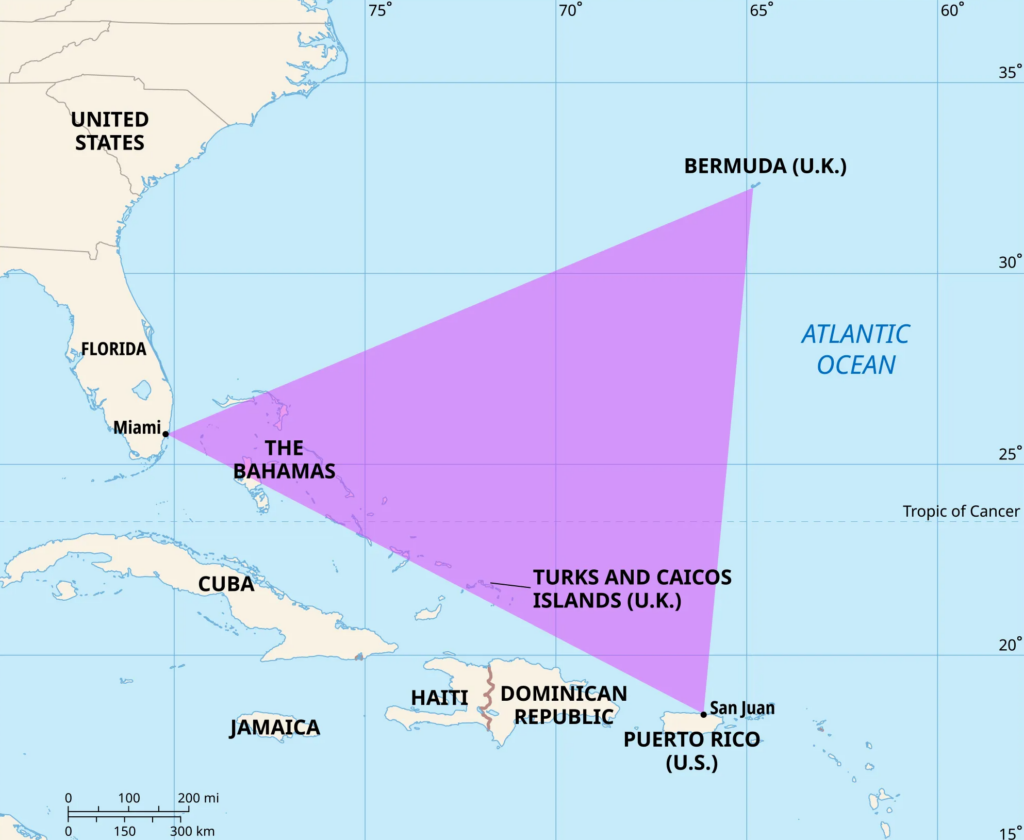
Miami, Bermuda and San Juan, Puerto Rico
None
The Devil’s Triangle
Vincent Gaddis (1964)
Alleged disappearances of ships and aircraft
No
Table of Contents
What is the Bermuda Triangle?
The Bermuda Triangle is a loosely defined area of the Atlantic Ocean where numerous ships and aircraft have reportedly disappeared under unusual circumstances.
Unlike countries, oceans or national parks, the Bermuda Triangle has no officially recognised boundaries. Most maps depict it as a triangle connecting:
- Miami, Florida
- Bermuda
- San Juan, Puerto Rico
Depending on the source, the size of the Triangle varies considerably because different authors have used different boundaries over the years.
Where is the Bermuda Triangle?
Although the Bermuda Triangle is commonly shown as a triangle between Bermuda, Florida and Puerto Rico, it is important to understand that this is simply the most widely accepted representation.
Some authors include larger areas of the Atlantic, while others draw much smaller boundaries. There is no international organisation or government that officially defines where the Bermuda Triangle begins or ends.
How Did the Bermuda Triangle Get Its Name?
Although unusual disappearances in the Atlantic had been discussed before, the term “Bermuda Triangle” did not become popular until the 1960s.
In 1964, writer Vincent Gaddis published an article titled The Deadly Bermuda Triangle in Argosy magazine. The article grouped together several maritime and aviation disappearances and suggested they might be connected.
Gaddis later expanded the idea in his book Invisible Horizons, but it was Charles Berlitz’s bestselling 1974 book The Bermuda Triangle that introduced the mystery to millions of readers around the world.
Why Did the Bermuda Triangle Get Famous?
The Bermuda Triangle became famous for a combination of real disappearances and compelling storytelling.
Several incidents attracted public attention during the twentieth century, particularly the disappearance of Flight 19 in 1945. Writers later grouped these unrelated events together and suggested that something unusual might be occurring within the Triangle.
Television documentaries, newspaper articles and books continued to build the legend, often highlighting mysterious details while giving less attention to conventional explanations. Over time, the Bermuda Triangle became part of popular culture and remains one of the world’s best-known mysteries today.
Famous Bermuda Triangle Mysteries
Flight 19 (1945)
Flight 19 consisted of five U.S. Navy TBM Avenger aircraft conducting a routine navigation training exercise from Fort Lauderdale, Florida.
During the flight, the instructor reported compass problems and became uncertain of his location. As weather conditions worsened, radio communication became increasingly difficult. The aircraft eventually disappeared, and despite one of the largest search efforts of its time, no confirmed wreckage was found. The disappearance became one of the defining events of the Bermuda Triangle legend.
USS Cyclops (1918)
One of the largest losses in U.S. Naval history occurred when USS Cyclops disappeared while carrying more than 300 people and a cargo of manganese ore.
No distress signal was received, and no confirmed wreckage has ever been found. The loss remains unexplained, although structural failure, severe weather and other conventional causes have all been proposed.
Star Tiger and Star Ariel
The British South American Airways aircraft Star Tiger (1948) and Star Ariel (1949) both disappeared while flying in the Atlantic.
Neither aircraft was ever recovered, adding further intrigue to the developing Bermuda Triangle story.
Common Myths About the Bermuda Triangle
Myth: Bermuda Is at the Centre of the Mystery
While Bermuda forms one corner of the commonly accepted Triangle, many of the most famous disappearances occurred much closer to Florida and the Bahamas than to Bermuda itself.
Myth: Every Missing Ship Was in the Bermuda Triangle
Many disappearances commonly attributed to the Bermuda Triangle actually occurred well outside the area or have no confirmed connection to it.
Myth: Aircraft Avoid Flying Through the Bermuda Triangle
Commercial aircraft routinely fly through or over the region every day without incident.
Myth: Ships Frequently Disappear Without Explanation
The Atlantic Ocean is one of the busiest shipping regions in the world. While accidents do occur, studies have generally not shown the Bermuda Triangle to have an unusually high accident rate compared with other heavily travelled ocean regions.
Scientific Explanations
Weather
The region experiences rapidly changing weather, thunderstorms, tropical storms and hurricanes that can quickly create hazardous conditions for ships and aircraft.
Human Error
Navigation mistakes, poor decision-making, fatigue and pilot error have contributed to many aviation and maritime accidents worldwide and are believed to explain some Bermuda Triangle incidents.
Gulf Stream
The Gulf Stream is a powerful ocean current that flows through the region.
If an aircraft or vessel is lost, this current can quickly carry floating debris away from the accident site, making recovery much more difficult.
Compass Variation
One of the earliest explanations involved unusual compass readings.
While compass variation is real, navigators understand how to account for magnetic variation, and there is no evidence that the Bermuda Triangle experiences unique magnetic anomalies compared with other parts of the world.
Ocean Depth
Large areas of the Atlantic within the Bermuda Triangle are several kilometres deep. Wreckage that sinks into these depths can be extremely difficult to locate.
Rogue Waves
Scientists have suggested that unusually large rogue waves may occasionally occur in the Atlantic and could potentially overwhelm vessels under the right conditions.
Methane Hydrates
One theory proposes that methane gas released from the seabed could reduce the density of seawater and affect buoyancy.
While this remains an interesting scientific hypothesis, there is currently little evidence linking methane hydrate releases to specific Bermuda Triangle disappearances.
Is the Bermuda Triangle Really Dangerous?
Although the Bermuda Triangle has an enduring reputation for mystery, most researchers conclude that it is not significantly more dangerous than other heavily travelled regions of the Atlantic.
Thousands of commercial flights and ships safely cross the region every year, and many incidents once considered mysterious have since received plausible explanations involving weather, navigation or human error.
Frequently Asked Questions
Is the Bermuda Triangle real?
The region itself is real, but there are no official boundaries and no scientific consensus that it is unusually dangerous.
Can planes fly through the Bermuda Triangle?
Yes. Commercial and private aircraft fly through the area every day.
Is Bermuda inside the Bermuda Triangle?
Yes. Bermuda forms one of the three commonly recognised points of the Triangle.
Do cruise ships travel through the Bermuda Triangle?
Yes. Cruise ships travelling between the U.S. East Coast, the Caribbean and Bermuda regularly pass through parts of the region.
Why hasn’t all the wreckage been found?
Deep water, strong currents such as the Gulf Stream and severe weather can make locating wreckage extremely difficult.
Conclusion
The Bermuda Triangle remains one of the world’s most fascinating mysteries—not because there is evidence of supernatural forces, but because it combines real historical disappearances with decades of speculation and popular culture.
Whether you view the Triangle as an unsolved mystery or simply a region where weather, navigation and human error occasionally combine with unfortunate circumstances, its story continues to capture the imagination of people around the world.
For visitors to Bermuda, the Triangle is part of the island’s cultural identity and history, but it should not overshadow what Bermuda truly offers: beautiful pink-sand beaches, a rich maritime heritage, and a modern island that welcomes visitors from around the world.
A great place to learn about the Bermuda Triangle is at the Bermuda Underwater Exploration Institute
